Weather-Controllable Video World Model
MeteoVerse
1Harbin Institute of Technology 2Huawei
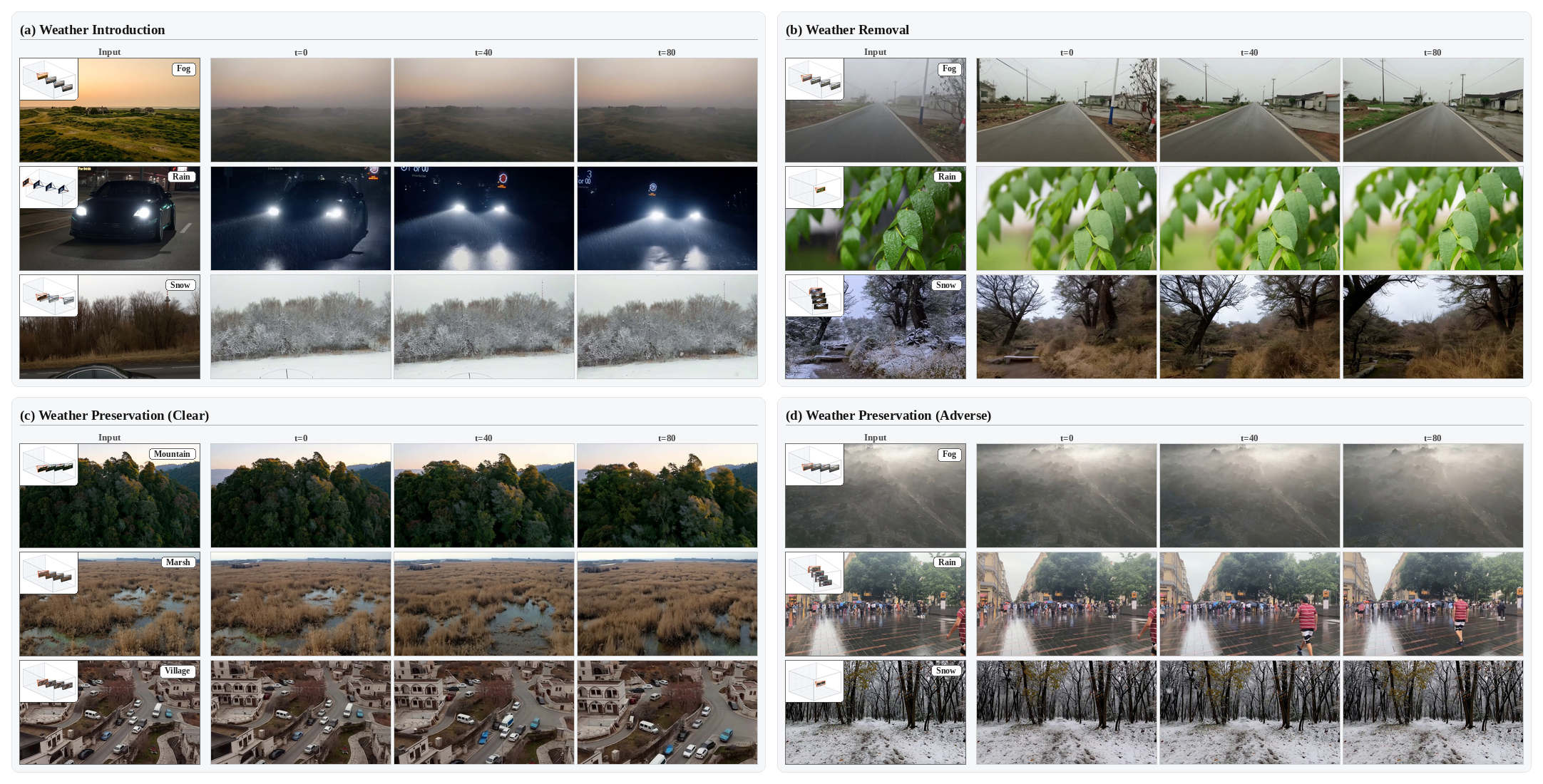
Predict camera-controlled future video from a single sunny or adverse-weather image while explicitly controlling weather preservation, introduction, and removal.
Overview
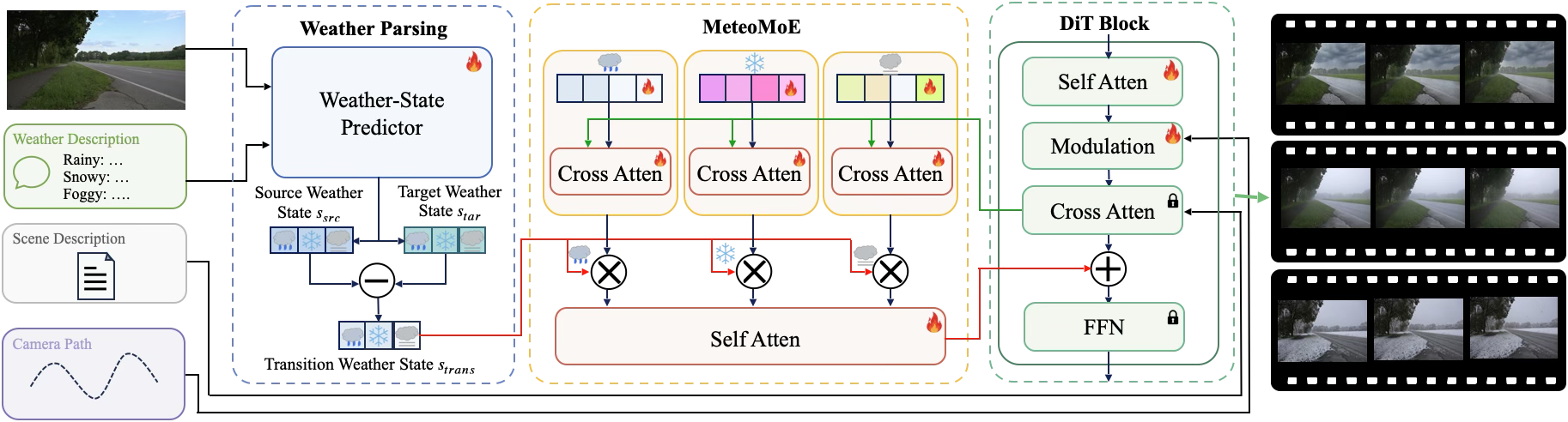
Video world models aim to predict future content from an observed scene while following prescribed camera motion. Real-world scene evolution is determined not only by changes in viewpoint and object dynamics, but also by environmental conditions such as weather, which can substantially alter scene appearance and visibility. MeteoVerse explicitly represents the required weather transition between the observed and target weather states and uses a transition-aware mixture of weather experts to realize controllable weather evolution.
Method
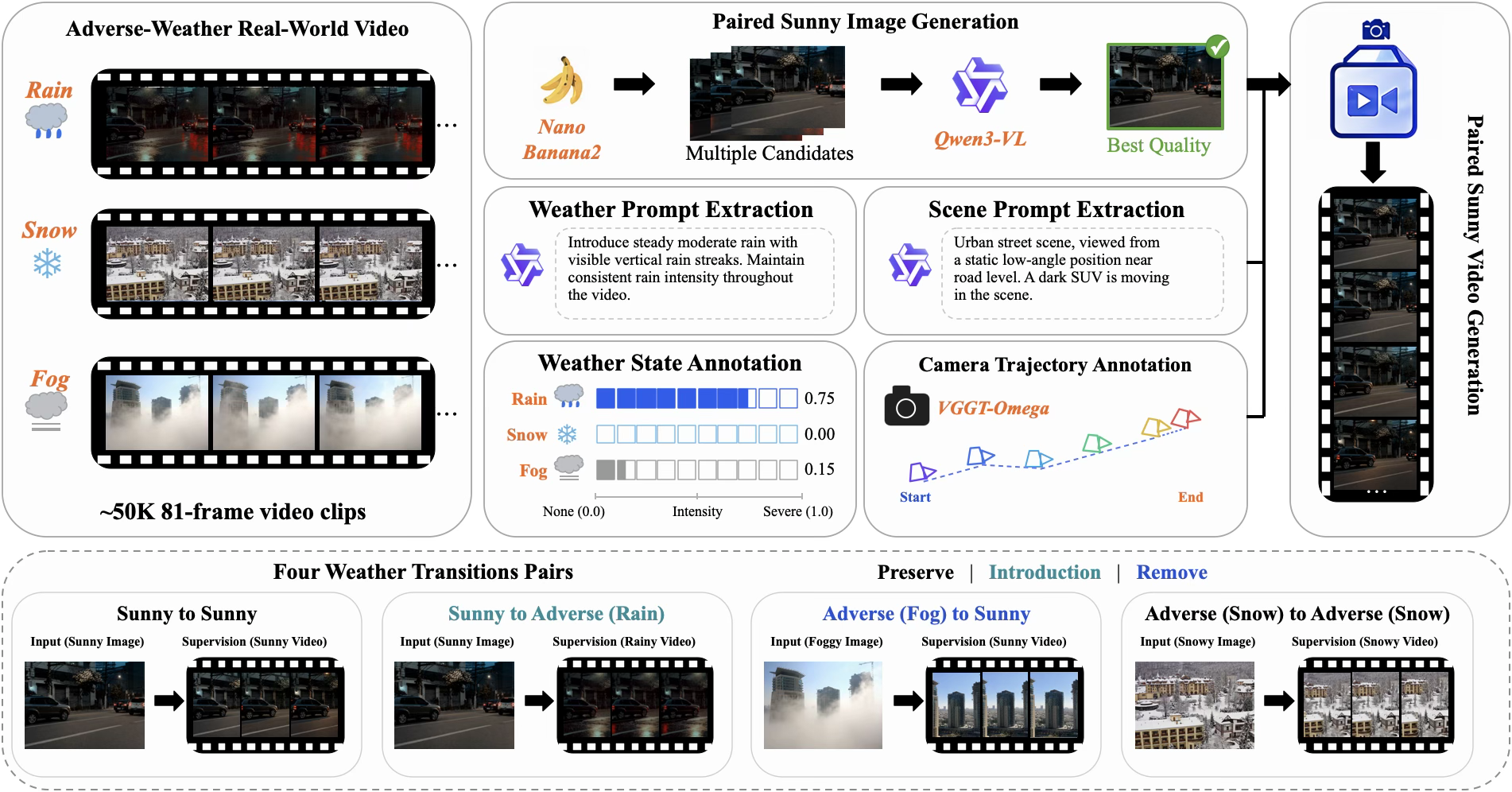
A target-weather instruction specifies the desired condition, but the required modification also depends on the weather already present in the observation. MeteoVerse makes this transition explicit and injects only the required weather modification into the pretrained video world model.
Supplementary video results
Weather Control Comparisons
10 samples · 4 weather settings · 6 methods
Fine-grained weather introduction
Intensity Control
Starting from a sunny input, only the requested target weather intensity is varied while the scene description and camera trajectory remain fixed. Each row shows the same scene and camera motion across five target intensities, making the progression easy to compare.
Citation
The arXiv identifier can be added after the preprint is posted.
@article{wu2026meteoverse,
  title   = {MeteoVerse: Unified Weather-Controllable Video World Model},
  author  = {Wu, Renlong and Wang, Guanqiao and Shang, Xuan and Yin, Hanming and Sheng, Xiaoxiao and Huang, Tianyu and Li, Hui and Zuo, Wangmeng},
  journal = {arXiv preprint},
  year    = {2026}
}